
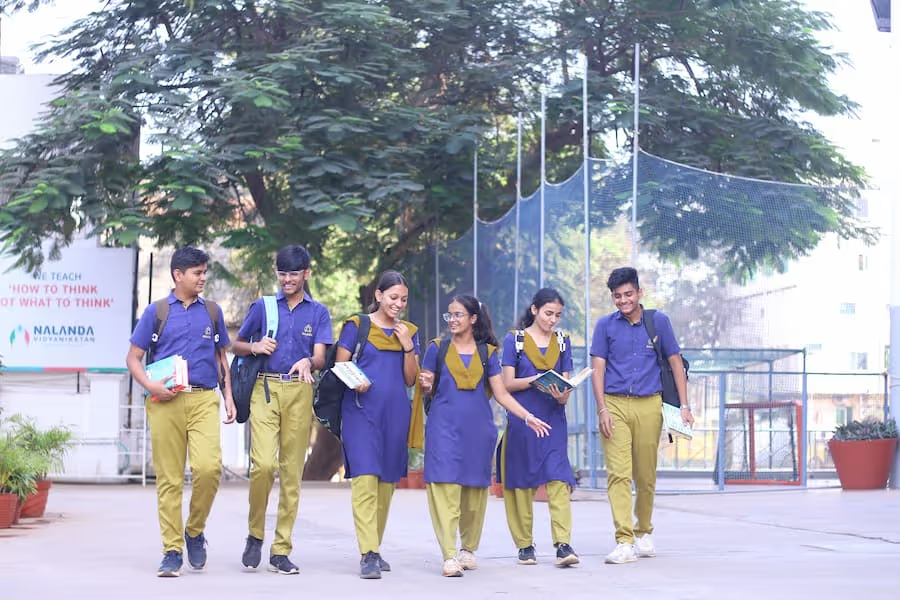
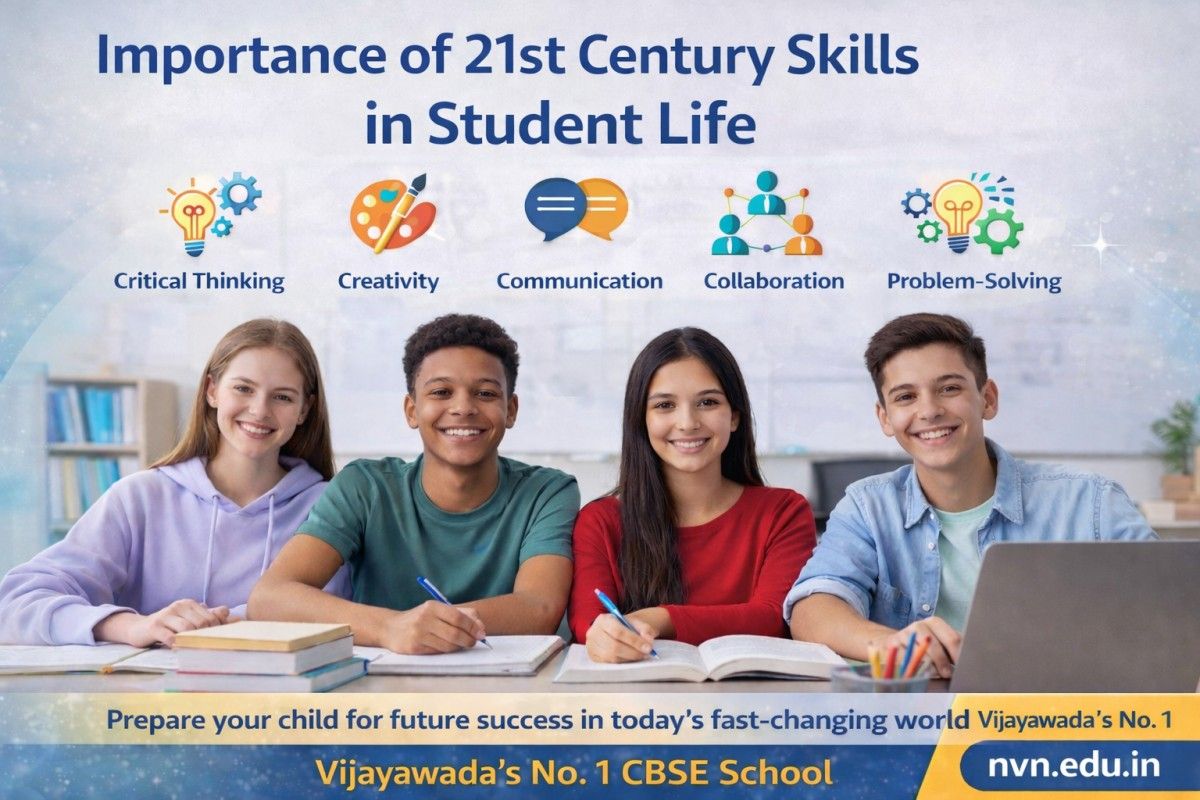
In today’s fast-changing world, academic knowledge alone is no longer enough for a child’s long-term success. Students now need a strong set of life and learning skills that help them think clearly, communicate well, adapt to change, and make responsible decisions. These are known as 21st-century skills. From problem-solving and critical thinking to digital awareness and collaboration, these abilities prepare children not only for future careers but also for real-life situations. For parents, understanding the importance of 21st-century skills is important, as these skills shape confident, capable, and responsible learners who are ready to face global challenges with clarity and discipline. At Nalanda Vidya Niketan, a leading CBSE school in Vijayawada, these skills are thoughtfully integrated into everyday learning to prepare students for higher education and real-life responsibilities.
What Are 21st Century Skills Every Student Needs Today?
21st Century skills are essential abilities that prepare students for real-world challenges beyond textbooks. They include critical thinking, communication, problem-solving, collaboration, digital literacy, and adaptability, helping children perform confidently in school, future careers, and life. These skills enable young learners to handle complex situations, interact effectively, and engage meaningfully in a changing, globalised society.
Importance of 21st Century Skills in a Student’s Education
For today’s parents, one question matters more than ever: Will my child be prepared for the world they will grow into, not just the one we know today?
This is exactly where 21st century skills become essential.
As a result, education must prepare students for conditions that may not yet exist.
Global workforce studies indicate that by the end of 2025, nearly 85 million jobs may be displaced due to automation and technological change, while 97 million new roles are expected to emerge. These new roles will not depend only on academic knowledge but on skills such as adaptability, problem-solving, communication, and independent thinking.
Among all 21st century skills, adaptability stands out as the most essential. Students who can adjust to new tools, new environments, and new expectations remain relevant even when industries change. This skill ensures long-term stability rather than short-term success.
Traditional education models focused heavily on memorisation. However, modern learning frameworks now prioritise competency-based education. This includes critical thinking, creativity, collaboration, and decision-making. These skills allow students to apply learning in practical situations rather than relying only on fixed answers.
Another important factor is long-term employability. Young professionals often fear becoming outdated early in their careers. Students who develop leadership, flexibility, and learning agility during school years are better equipped to handle this challenge and continue growing as industries evolve.
For parents, this means investing in an education that prepares children for uncertainty, not just examinations. At Nalanda Vidya Niketan, the focus on 21st century skills ensures that students are academically sound, mentally prepared, and capable of managing change in a rapidly evolving economy.
Three Core Categories of 21st Century Skills Taught at Nalanda Vidya Niketan
At Nalanda Vidya Niketan, students are guided to build a strong foundation not only in academics but also in key skills that matter in today’s world. These skills are grouped into three major areas, Learning Skills, Literacy Skills, and Life Skills that together support confident, thoughtful, and adaptive learners.
21st Century Learning Skills for Students (The 4 C’s)
Learning skills are core abilities that help students understand information deeply and solve real‑world problems. These are often called the Four C’s:
- Critical Thinking: This is about making sense of information by examining facts carefully and forming logical conclusions. In life and careers, the ability to think clearly and reasonably remains a valued skill.
- Creativity: This refers to generating new ideas and looking at situations in fresh ways. In today’s changing world, creative thinking helps students face challenges with innovative approaches.
- Collaboration: Working effectively with others, respecting different views, contributing ideas, and sharing responsibilities, enables students to succeed in teams, whether in school projects or future workplaces.
- Communication: This is the ability to express ideas clearly and listen to others with understanding. Good communication skills help students perform confidently in classroom discussions, presentations, and group activities.
These learning skills form the basis for thoughtful decision‑making and meaningful engagement with ideas, strengths that matter at every level of education.
21st Century Literacy Skills for Students
Literacy skills help students make sense of the world’s information and use digital tools appropriately. In today’s information‑rich environment, these skills are essential:
- Information Literacy: Students learn to find, evaluate, and use facts and data from different sources responsibly. This fosters careful thinking rather than relying on assumptions.
- Media Literacy: With so much content available through media, students learn to understand how information is presented, how messages can influence opinions, and how to recognise trustworthy sources.
- Technology Literacy: Being comfortable with digital tools, from computers to educational software, helps students work efficiently and confidently in all subjects.
These literacy skills support safe and effective use of technology and help students become informed users of information in many forms.
21st Century Life Skills for Students
Life skills focus on personal growth, social understanding, and practical abilities that support success beyond the classroom:
- Flexibility: This means adapting to new situations and being open to change. Students who adapt well can navigate challenges and adjust their thinking when needed.
- Leadership: Developing leadership helps students guide others, take responsibility, and make thoughtful decisions that benefit groups.
- Initiative: Students learn to take action independently, setting goals, planning steps, and following through without constant direction.
- Productivity: This involves managing time and tasks wisely so that students can complete work efficiently while balancing other responsibilities.
- Social Skills: These include building positive relationships, showing respect, and communicating well, all of which are important for personal and professional success.
Life skills help students grow into confident individuals who can handle academic pressures, social interactions, and future career demands.
Learning Methods to Prepare Students for 21st Century Challenges
- Interactive, Technology‑Enhanced Classrooms: At Nalanda Vidya Niketan, smart boards, digital tools like Moodle and Quizziz, and e‑books are used to make lessons involving thinking and problem solving more engaging. These tools encourage students to explore ideas actively rather than just memorise content, preparing them for modern academic and professional environments.
- Self‑Directed and Inquiry‑Based Learning: The school promotes self‑learning from early grades, helping students take ownership of tasks, ask the right questions, and seek answers independently. This practice strengthens critical thinking, research skills, and confidence, all needed for future challenges beyond routine classroom work.
- Collaborative Projects Across Subjects: Students at Nalanda Vidya Niketan engage in group projects that connect concepts from science, language, arts, and technology. Working together on meaningful assignments helps children improve communication, teamwork, and real‑world reasoning.
- Guided Research and Presentation Skills: Through structured research assignments and opportunities to present findings, students learn how to gather information, organise it logically, and communicate results clearly. These activities build analytical skills and confidence in speaking, key abilities for future education and careers.
- Creative Language and Expression Activities: Regular assignments involving storytelling, debates, and communication practice help students develop strong language skills. This improves both written and oral expression, helping children articulate ideas clearly, a critical skill in leadership, academia, and professional life.
- Collaborative Problem Solving Through Team Engagement: Group work and collaborative learning, part of the school’s methodology, encourage students to solve challenges together, building social understanding and shared responsibility. These methods mirror teamwork in real workplaces and social settings.
- Healthy Competition to Build Initiative: Students participate in academic, cultural, and inter‑school activities that create a positive competitive environment. Such activities encourage initiative, persistence, time‑management and leadership qualities that contribute to long‑term personal and professional success.
In today’s fast-changing world, academic knowledge alone is not enough. Children need skills like critical thinking, communication, problem‑solving, collaboration, and digital awareness to navigate real-life challenges confidently. At Nalanda Vidya Niketan, these essential 21st‑century skills are part of everyday learning, helping your child become thoughtful, capable, and ready for the future. Give your child the advantage of Vijayawada's No. 1 school. Visit nvn.edu.in to explore our programs, schedule a campus tour, and see firsthand why thousands of parents trust NVN with their children's future.